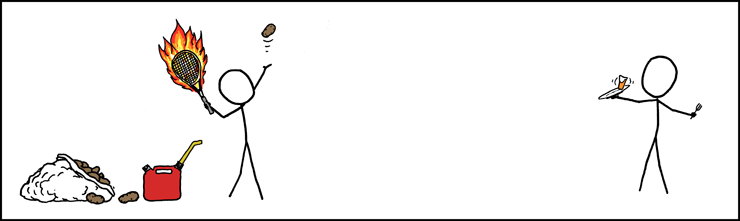
Thursday, June 5, 2008

Powers of Ten


Cool video from the 70's demonstrating scale first by zooming out and then by zooming in. Neat way to look at huge numbers and the relative size of things. The film stops at the subatomic layer with the mention of quarks. I wondered what it would look like based on today's understanding of the atom so I did a quick search and came up with all kinds of visualizations of the different types of quarks.

I left school (K-12) with a picture in my mind of an atom that looked like planets circling the sun. Any of you who went to school in the fifties or sixties will remember this. (The picture above is close to what I remember in my high school text book.) I had this image as a working frame of reference for years until I sat down with a science teacher at a conference once and he explained that my "planetary" model wasn't really current. He gave me a short description of current thinking and never laughed at me once.

This demoed two things to me. One, knowledge changes (possibly expands would be a better word). We hear about information learned in a science class being obsolete by the time a college student graduates. My world view in terms of this particular bit of science was out of date and I didn't know it. I don't know if this changed anything in my life?

The second thing this experience helped me realize is the power of a good illustration or visual. I am a strong visual learner. If I can see it, it helps me to understand it. At the time I was taught the first illustration, science had already moved beyond that picture. I know why textbooks liked it. It was clear. It was concise. You could label the parts on a quiz. The second illustration is not quite so simple. It's a little harder to label. But, it does give me a better way to visualize an atom.

For all I know, my science teacher told me that the first picture wasn't a perfect illustration. He may have even talked about the current understanding of an atom. He may have drawn other pictures on the board. But, it was the first one that I remembered and used in my mind on those occasions that I thought about atoms.

As teachers we need to remind ourselves often that the "Map is not the territory." Illustrations are good. Visuals are important. But they are abstract and sometimes young concrete thinkers confuse the symbol with the reality.


[Image captured from Wikipedia: Atom: http://en.wikipedia.org/wiki/Atom]
[Image captured from "Rust never sleeps": http://http://www.glenair.com/qwikconnect/vol7num4/atom_illustration.jpg&imgrefurl=http://www.glenair.com/qwikconnect/vol7num4/coverstory.htm&h=341&w=288&sz=13&hl=en&start=2&sig2=KqFhrH4FXb5NsyeXcTRU_Q&um=1&tbnid=_y_eols1Bxt8oM:&tbnh=120&tbnw=101&ei=SsM6SJ6BCIeOigHxjYG7CA&prev=/images%3Fq%3Datom%
2Billustration%2Bwrong%26um%3D1%26hl%3Den%26safe%3Doff%26client%3Dfirefox-a%26rls%3Dorg.mozilla:en-US:official%26sa%3DG]

Wednesday, June 4, 2008

Concentration


I took a part-time job recently scoring written responses to a state test. The task was challenging and tedious. I worked in a large room with several hundred people broken up into smaller groups. Cell phones had to be turned off. We were asked to talk in our "library voices." We couldn't wear headphones or any kind of music player.

The music player thing made sense to me as a teacher. I don't allow my students to listen to their players except for very specific circumstances. I know that some classrooms ban them completely. In the middle school where I used to work, if we saw them, we were required to confiscate them. Actually, all the rules about noise made sense. We were reading and thinking and the quiet atmosphere made sense.

Here's the thing.

I had a hard time concentrating. Once I was competent in scoring a response and I had done over fifty or so, my mind wanted to wander. Any noise. Any laugh, cough or sneeze was enough to pull me out of my head into the world in which I sat. When there was appropriate discussion between our supervisor with someone, I listened. If there was inappropriate discussion about the traffic, the job or the air conditioner, I listened. I didn't have to be part of the discussion. It could be the two folks next to me or at the table behind me or across the room. I stopped scoring and attended to the distraction. Then I'd have to rein in my roaming attention and bring it back to the task I was being paid to do.

At home, I can control my environment to the point that I can sit for 3-4 hours and concentrate on a task. I don't do this with the TV on as I end up watching and not working. I can listen to music as long as it has no words or I stop working and start singing. If I really need to shut out the world and focus completely, I listen to white noise through my iPod. When I have control of my environment, I'm able to attend to a task for long periods of time. So, my experience with this scoring job has got me to thinking about kids and their music players. Maybe it's not that they are always trying to do more than one thing at a time or trying to block us out. Maybe they are trying to limit their inputs so they can focus? (At least some of the time.)

Rather than telling kids what they can't do, maybe I need to spend some time telling them how to better utilize the tools they have. I know I 'll share my experiences with my students next year when we talk about appropriate use of personal electronics. We all can learn to work smarter. It just may not look the same for everyone.

[Image: "distraction": Al Gunn]

Tuesday, June 3, 2008

Thumb Piano


Saw this idea for using a grounding block to make a thumb piano somewhere last spring but I only got as far as pricing the pieces at my local hardware store before getting sidetracked by other things (not unusual for me). Forgot about it until this posting on Make about a cool looking thumb piano.

There are lots of good shots of the builder's finished instruments and some modifications he made to add some buzzing to the sound on his flickr photostream.

While searching for some information on grounding blocks, I found what I think is the first post I saw last year on Instructables. It is by the same guy who made the one shown.

When I went looking for a grounding bar, I had a few difficult moments explaining to the gentleman at the hardware store what I wanted. It didn't help that I needed one to build a musical instrument and really didn't know the real use of the item except that vaguely it was used for "grounding". After searching the electrical section of the store he eventually helped me find it.


To save you some time I captured a picture of a grounding bar in the package and a link to Ace Hardware. This link may not last forever and if it gets changed just go to Ace and search for "ground bar kit". Or print this picture out before heading off to the store. Maybe you can avoid having your hardware clerks whisper about you and draw straws to see who has to wait on you while you wander the aisles.


[Image from flicker: Uploaded on May 13, 2008 by yapruder: http://www.flickr.com/photos/41969054@N00/2490215681/]

[2nd Image captured from ACE Hardware Site: http://www.acehardware.com/product/index.jsp?productId=1297989&cp=&sr= 1&origkw=grounding+bar&kw=grounding+bar&parentPage=search&searchId=35421302134]

Monday, June 2, 2008

Low Tech Palm Pilot


Before I ever had a PDA, I had my hand to jot down phone numbers, call numbers for books at the library, addresses and names. Sometimes they lasted long enough for me to make a hard copy at home. Usually they lasted long enough for me to complete my task. Here is a company who has made the process better (?) by giving you a template of a blank to-do list you can tattoo onto your hand. They include a handy marker that you can use to fill in the blanks. The company that makes these tattoos (markets them?) is called Fred & Friends.

By the way, in case you were wondering what my second most common place is to take notes? Fast food napkins. Numerous story ideas, sketches and the usual phone number/address info got their start on a paper napkin while eating lunch at any number of hamburger joints. Numerous bits of these data memes also ended up as little glumps of useless paper after going through the wash. Any day some enterprising young entrepreneur will start offering grainy, flimsy napkins in a handy notepad pack. Just perfect for capturing that million dollar idea! Possibly water resistant so those brilliant thoughts won't be destroyed by the rinse cycle. But I digress.

Fred & Friends has a bunch of items I've seen referenced on the web before but never bothered to follow up on. Like a delete fly swatter (wacker shaped like a delete key), Holy Toast Makers (make your toast a religious experience) and Pick Your Nose cups (cups with noses on them that look like they belong to you when you drink). The embedded video highlights the Pick Your Nose cup. It is hard to explain but makes perfect sense once you see it in use!

Look through their catalog and you'll find at least one silly-gag or possibly unbelievably useful gift item. I've not bought anything from them (yet) so can't vouch for the company, but I am already writing up a wish list. Maybe by the time I get my order ready, they will have that whole waterproof/napkin/notepad idea worked out and on the market?


[Image captured from Amazon: http://www.amazon.com/s/sr=41-226/qid=1192045941/
ref=sr_in_F_p_4_225/104-3140738-5983938?ie=UTF8&rs=284507&field-brandtextbin=
Fred&rh=n%3A1055398%2Cn%3A284507%2Cp%5F4%3AFred&page=1]

Thursday, May 29, 2008

Building a Shed


I've been thinking about building a shed. I live in a suburban neighborhood and I don't want the shed to be taller than my fence as my neighbors already have to look at me in my summer cut-offs and sexy, stained TIE conference t-shirt during the summer. They don't need to have a shed in their line of sight too.

I looked at a few pre-built buildings and they are either too tall or too small for what I want. What I want is a place I can keep my mower and various tools. My garage isn't big enough for all the garden stuff, my power tools and two vehicles. Part of the reason this project has been on the back burner for so long is that the part of my yard where I want it is slanted and covered in rock. I hate moving rock!

Seeing this article on Make about a man who built his own shed has got me motivated to at least come up with a design. He has several features that I may adapt to my own situation. He uses four strong corner posts. I think I could do something like that and it might save me lots of time trying to level an area of ground and moving all that rock. He also has a lattice system for the floor that he then fills with gravel. I could do something similar and once again save some time in regards to leveling the area where I want to build.

Now I just have to figure out how to make something that isn't tall but is still functional. I am currently playing with the idea of a roof that can be lifted up. I guess rather than a shed, it would be more like a big storage box with a door on one side where I could roll in the mower.

If I actually do get any further than thinking about it, I will post some pictures.

[Image captured from http://www.yourmissus.com/shed/pages/DSCN0417.html]

Wednesday, May 28, 2008

Egg Smashing Goldberg Machine


I'm a sucker for these Rube Goldberg machines. If you're trying to design your own machine, this video has at least a dozen possibilities you could adapt for your own contraption.

Catchy music too!


[Image captured from video: Creme that Egg: http://www.youtube.com/watch?v=vrCb_fNmSTA&eurl=http://www.blogger.com/post-edit.g?blogID=19364023&postID=983807203462776513

Tuesday, May 27, 2008

High school student isolates microbe that breaks down plastic


Saw a reference to this article and tracked it down at TheRecord.Com. Seems that a Daniel Burd, a high school student in Canada, got curious about how to deal with all the plastic he saw around him. He started experimenting to find the microbes that eat it. His thinking was if he could isolate them and concentrate them, then maybe he could speed up the process. (Anything that might shorten the 1000 year process would be helpful) He succeeded and won the Canada Wide Science Fair along with a $10,000 dollar prize and a hefty scholarship.

Read the article for a description of how he set up his experimental process. Interesting.

Share this with your students when they complain about not being able to do anything. Inspiring.

[Image captured from Youth Science Foundation Canada: http://apps.ysf-fsj.ca/virtualcwsf/projectdetails.php?id=1390&year=2008&province=&keyword=plastic&name=&categoryid=3&divisionid=&regionid=]

Monday, May 26, 2008

Mars Lander

Here's one of the first pictures back from the Phoenix Mars Lander. A shot of the Martian arctic plains.

On Mars!

Another planet!

Come on....it's a picture sent from another freakin' planet!!!

When did landing a spacecraft on another world become so.....everyday? I remember going to the gymnasium of my elementary school to watch one of the early space shots on a black and white TV. We gathered around and the principal told us that history was being made.

Now it's a short clip on the evening news and maybe your kids science teacher will mention it tomorrow.

Check it out and follow the mission at the NASA site.


[Image captured from NASA: http://www.nasa.gov/mission_pages/phoenix/images/press/false_color_postcard_edr.html]

Doodle Winner


Google ran a contest where students could design a new Google logo based on the theme, "What if..." A winner was picked last week and it is a 6th grader from California, Grace (Suryung) Moon.

Grace describes her Doodle:
"My doodle, "Up in the Clouds," expresses a world in the sky. This new world is clean and fresh, and people are social and enlightened. Every person here is treated as family no matter who they are. The bright sun heats this ideal place with warmth, love, and brightens everyone's day."

For more information on the contest and links to see some of the runners up go here.

[Image captured from http://googleblog.blogspot.com/2008/05/we-have-doodle-4-google-national-winner.html]

Friday, May 23, 2008

Funny: The Tunstallator

KT Tunstall and animatronics. Who could ask for more? Possibly the Dylanator? I'm headed out to my garage right now!

Thursday, May 22, 2008

IM isn't destroying our language


We teachers who sit around the lunch room lamenting the language skills of our students and blaming email and instant messaging all have to take a step back after reading this article, Researchers: written English language will weather LOL storm and will need to find something new to blame.

"Everybody thinks kids are ruining their language by using instant messaging, but these teens' messaging shows them expressing themselves flexibly through all registers," Tagliamonte said in 2006 after completing the research for the paper. "They actually show an extremely lucid command of the language. We shouldn't worry."


Perhaps we can now blame teachers. Naw....how about parents. No, I like parents. I know, the government. If all else fails, blame the government!

Wednesday, May 21, 2008

Are you Hyperconnected?


No off switch: "Hyperconnectivity" on the rise is an article recently posted on ars technica. It discusses a new kind of worker that is constantly connected to work via their electronic devices. The lines between work and home are blurring for these folks and their numbers are growing.
"These individuals were found in all countries surveyed, though China and the US have the highest ratios. Banking and high-tech industries contained a higher concentration of hyperconnected individuals who are found most often in management positions, and 60 percent were under the age of 35. Hyperconnected individuals don't view themselves as early adopters of technology; their lifestyle simply seems normal."
What are the implications to productivity and a person's level of stress as the lines between work and home blur? Interesting article.

I've often thought that teachers suffered this problem even before the advent of computers, cell phones and other electronics. As a group we are notorious for taking our work home with us. We grade papers and plan lessons on the couch while watching Star Trek reruns. We take pictures, read books and attend events with a part of our brain always wondering how we could use this information in our classroom. Back when outside phone lines were limited and caller ID wasn't so easily available, I did many of my parent contacts in the afternoon and early evening when I got home. (Usually grading papers while I talked.)

Sit outside a school and watch teachers walk to their cars at the end of the day. English teachers are identifiable by the the crate of papers they haul with them. Many have those little portable airport luggage dollys to which they can strap down a box or two of ungraded essays for easy transport from desk to car to kitchen table. Go to any meeting and you will see at least one teacher who is grading papers while participating in the discussion. Some teachers look like they are taking copious notes during the weekly staff meeting, when in actuality, they are planning their lessons for tomorrows sub.

Educators have been multi-tasking for years.

[Image: flickr: "My Laptop Bag-Work Version" Uploaded on September 17, 2007 by JaseMan: Creative Commons]

Tuesday, May 20, 2008

Marble Adding Machine


Saw this Binary Marble Adding Machine on the Nuts and Volts site I posted about recently. I've watched the video several times now and am fascinated by the mechanical action.

Fun to show in a math class or a programming class. The author had this to say about how he designed the rockers.

"Also tricky was getting the rockers to consistently work. I spent a lot of time figuring out what dimensions to make them so that they would correctly work, even if two marbles arrive onto the rocker right on top of each other. I knew it was physically possible to build such a rocker, because the lego rockers I built into the original Lego marble machine had this property by a fluke. The trick turned out to be to make peak of the rocker, which divides the marbles, short enough, and the rocker shallow enough. That way, if a marble arrives before the rocker has had a chance to flip, the previous marble, which is still on the rocker, will deflect the next marble onto the other side, even if the rocker has not yet flipped. "
The web page has lots of closeup photos and design explanations.


[Image captured from http://woodgears.ca/marbleadd/]

Monday, May 19, 2008

Skills Revolution


Found this interesting article in New York Times by David Brooks called, "The Cognitive Age". Good discussion of globalization and how many politicians are missing the bigger issue. Here is a short juicy quote:
"The central process driving this is not globalization. It’s the skills revolution. We’re moving into a more demanding cognitive age. In order to thrive, people are compelled to become better at absorbing, processing and combining information. This is happening in localized and globalized sectors, and it would be happening even if you tore up every free trade deal ever inked."

[Image: Flickr: "This is my brain": Uploaded on November 23, 2006 by killermonkeys: Creative Commons]

Thursday, May 15, 2008

Nuts and Volts


While reading the latest issue of The Technology Teacher I came across a reference to this website, Nuts and Volts. The article referred to it being a good resource for teachers. So, I grabbed the URL and took a look.

First thing I discovered was that it's a combination print/online magazine. There were several projects I was interested in reading about but couldn't access because I'm not a member. To access all the content, you need to be subscribed. I saw several things I would of liked to read but couldn't get to. Enough to subscribe to the magazine? Not sure yet.

There is a lot of content here for the non-subscriber. They have an active blog that I enjoyed reading. I found a lot of tech related news and links to the source articles. There is enough here to bring me back even if I'm not a member.

You can sign up for a trial issue and subscription before laying your money down. I'm not sure I have time for one more monthly magazine? If anybody else out there is a subscriber, let us know what you think.

[Image captured from http://www.nutsvolts.com/preview.php?issue=69]

Wednesday, May 14, 2008

Fix your own bike


Saw a link for building your own recumbent bike posted on Make and since my brother-in-law keeps telling me I should get one of these, I checked it out.

The site is called How to Fix Bikes and the article on building a recumbent bike was interesting. The whole site is a nice little find. Lots of how to articles for working on your own bike. Now, I am not an avid biker and while I do own a bike I have to say I am not an expert on bikes or their maintenance and repair. Saying that, I found the articles I looked at to be clear and easy to follow. You can click on many of the photos to enlarge them. There are some video segments as well.

Check it out. You may not build a recumbent but you may be inspired to replace that rusty chain.

[Image captured from http://howtofixbikes.blogspot.com/]

Tuesday, May 13, 2008

Keyboard pants


These pants may be even a bit too geeky for me to wear. Now if you printed one on the left arm of a long sleeve shirt, I might consider that. After all I don't want to stand out too much in a crowd.

Or...I had a thought looking at these jeans. When I am running laps I sometimes keep track of the count by placing my thumb on the joints of my fingers. I start with the first joint of my pinky. If I move over each joint of my little finger to the tip I can count up to four. Four fingers lets me keep track of up to 16 laps.

Two hands gives the possibilty of 32 pointers. More than enough to create a keyboard using the possible two hand combinations. It wouldn't be any more awkward than some of the miniature phone keyboards folks use now a days. Also it would help you avoid some of the embarrassing keyboard pants jokes you'd be the brunt of if you wore these pants. Like:
"That boy is spending way too much time hitting the space bar!"
"All that touch typing will make you go blind!"
"Hands off the keyboards!"

"No hitting below home row!"
"Keep a cap lock on that or it's going to get you in trouble some day!"
"Men don't care about your keyboard, only their own!"
Adolescence is tough enough. Adulthood ain't always a piece of cake either. I think I will skip the pants.

[Image captured from website: http://www.vouspensez.com/2008/04/22/the-geekiest-pants-ever/]

Monday, May 12, 2008

Two Million Minutes


Two Million Minutes is a documentary that follows six students through high school in India, China and the United States. The title refers to the number of minutes a student spends in high school. I've embedded the trailer below. The web site has lots of interesting information on how our educational systems differ. I haven't seen the film yet but am going to try and make it to one of the screenings. It sounds thought provoking.

The executive director of the film, Robert Compton says in one of the related videos that American students say they "can't" do something when they score badly in a subject. Foreign students say they did badly because they didn't "work hard enough." He adds, "They don't set limits on themselves."


[Image captured from video Two Million Minutes: Trailer: http://www.youtube.com/watch?v=xZnSG6gg1vs]

Thursday, May 8, 2008

Dirty Keyboards and Sick Children

During one particularly bad flu and cold season several years back, my building had 3-5 kids missing from most of our classes due to a nasty virus that was going around. I was standing in the computer lab listening to the kids coughing and sneezing. I watched one young man sneeze. He shielded his face from the kids on either side of him and directed the stream of germs right onto the keyboard. He wiped his hands on his pants and continued typing. Besides getting grossed out, I started thinking about how germs are spread.

We started talking to the kids the next day in the technology department about washing their hands and explained that like their hands, the keyboard was one way to transfer the cold and flu virus. I bought some wipes and we started cleaning the keyboards daily. If I had a student who was actively coughing, I made sure that keyboard got cleaned before the next child sat down. I was lucky to have a sink in one of the labs and was always making the kids wash their hands. A lot.

I don't know if it helped limit the overall spread of disease in our school, but after that, I got sick less. I was reminded of this event by this post on ars technica: Study: keyboards make excellent homes for nasty bacteria. I love this quote from the article:
"...several keyboards were highly contaminated, and at least one was removed on the scientist's advice as it harbored four times the amount of harmful bacteria compared to a toilet seat"
I never used the toilet analogy with my students and staff before but I will from now on. I can hardly wait to put together my new graphic.

[Note: This story seems to have gained some momentum since I read it last week. Here are some related posts from ABC news.
[Image:Uploaded on March 9, 2006 by Lawrence Whittemore: Creative Commons]

Wednesday, May 7, 2008

Robotics in the Classroom


The NXT STep has an interesting post with lots of pictures about Robotics Projects, a graduate level class for teachers on how to use NXT Mindstorms kits in the classroom. This picture is an example of one of the final projects.

It sounds like my kind of class. I looked into it and found the following links.

Link to the class wiki.
Link to the Wichita State Robotics in the Classroom site.
Link to Wichita State College of Education

[Image captured from The NXT Step: http://thenxtstep.blogspot.com/]

Tuesday, May 6, 2008

Build an ornithopter


Make has a video posted on how to build an ornithopter. I saw this project in the magazine (volume:08) when it came out, thought "neat" and then forgot about it until now.

It looks fun. I am wondering if it could be scaled up and still fly? I may try this out.


Build an Ornithopter - video powered by Metacafe

Monday, May 5, 2008

Number of bloggers growing


I often wonder if blogging has hit it's peak? I wonder if it is just this generation's CB Radio and will fade away leaving only a few of us writing these online diary thinga-ma-bobbers? I wonder if anyone other than my sweet, supportive sister-in-law in Minnesota ever reads my blog?

This article from ars technica says no. Blogging is not dead. At least not yet. Here are a few juicy items from the post.

  • 45% of the internet users surveyed have started a blog (up 14% since 2007)
  • Asia has the fastest growing population of bloggers (over 70% in several countries)
  • 63.5% of us keep a personal blog and most write about their daily life
  • 82% of those internet users watch online video (50% increase since 2006)
  • Americans would rather read blogs than make them (72% read blogs regularily)
So, I guess I am still going to teach my students how to set up and maintain a blog next year. That's a relief, I thought I might have to plans a few new lessons.

"Thats a Four-Ten Good Buddy. It's time to Get Gone and then Get Horizontal. Over and Out!"

[Image: Typing hands-take two: Uploaded on May 20, 2006 by Tojosan: creative commons]
[Note: My CB is a little rusty...I either said I'm signing off and going to bed. Or that I am dead? My apologies to all you truckers out there...and I'm not dead!]

Thursday, May 1, 2008

DIY Photo Studio Product Lighting


Sweet little video from Make on how to set up your own product lighting for a photo shoot. Say you have a small object like a purse or a set of headphones or your action figurine of the Hulk. Here is a way to light it with no shadows on the cheap.


[Image captured from "Episode 2, DIY Photo Studio Product Lighting"; http://www.youtube.com/watch?v=-zARqGgHjNc&eurl=http://blog.makezine.com/archive/2008/04/ diy_photo_studio_product.html?CMP=OTC-0D6B48984890]

Wednesday, April 30, 2008

Make your own toys


I made one of these spool tanks when I was in Cub Scouts way back before they ever put a man on the moon. I believe it was one of the first things I ever built. It was fun to play with. It taught me some things about simple machines. I used a real knife to carve the notches in the spool and didn't cut off my thumb!

Mechanical Toys is a site that has directions for making a spool tank, a rubber band gun and a bunch of other cool toys. There are photos and diagrams for building most of the projects mentioned (some have a coming soon message). There are also links to other mechanical toy sites.

Now if I can only find a wooden spool in the junk box in my garage.

[Image captured from Mechanical Toys Page: http://users.bigpond.net.au/mechtoys/index.html]

Tuesday, April 29, 2008

Second Language


The Fischbowl recently had a link to this article: Rensselaer to Require All Engineering Students to Study Abroad. It has an interesting discussion about engineers needing a second language because "their eventual careers may require them to collaborate with international clients or co-workers".

I told a teacher I was interested in a science career when I was around 12, he recommend I take German as a second language because so much research was coming out of Germany. Another teacher in high school suggested Russian might be useful to someone going into science for the same reasons. I wonder what language I might recommend to a student today asking me the same question? Chinese? Japanese?

In the late 90's I had a principal who looked into setting up a Chinese language class at the middle school where I was teaching. She was unable to find a teacher who fit our needs at the time so it never came to pass, but she was already thinking ahead of the curve. I know that in a lot of schools, World Languages have taken a back seat to kids trying to meet all their academic requisites. Is it time to re-think our school policies towards a World Language? Should it be an elective or required? Do we need to look beyond the traditional German, French and Spanish?

[Image: Chinese word for luck captured from http://www.chinapage.com/word/chineseword.html]


Monday, April 28, 2008

Clothing Color Palettes

One trick I've use in the past when students are having a difficult time creating a color scheme for a web page is to have them borrow a palette from nature. Pick a picture of a flower or a tree or a mountain vista and then open it up in Photoshop. Use the eyedropper tool to grab the color hex number for three to five colors. Create a second layer and then draw a thick line of each color across the picture. Does it look good with the picture? Hide the photo. Do the color swatches look good together?

Instant color palette!

I ran across a site that does something similar, Wear Palettes. It takes outfits that are posted on another site that are considered fashionable and then uses those photos to create a palette.

Fashion is not my thing.

Clothes are not my thing.

The women in my life will attest to my poor taste in clothes and attrocious color sense. Yet there are lots of kids who are into clothes and fashion. Here is one way to help them bring an outside interest into their web design projects.

All kids struggle (OK maybe only I struggle) with matching their clothes in the morning. Getting them to think about their clothes gives them another way to think about color and design.

[Image captured from Wear Palettes: http://wearpalettes.blogspot.com/search/label/army]

Friday, April 25, 2008

Funny: You are getting warmer...

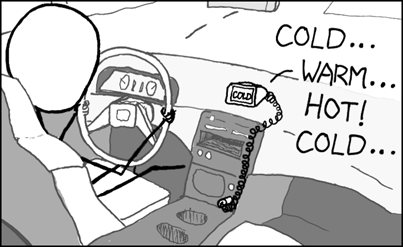
GPS as my mother would have created it...


[Original comic from http://xkcd.com/]

Thursday, April 24, 2008

Planning for Presentations


Another slideshow from Rowan Mahanan about putting some thought into who your audience is before creating a presentation.

Some good tips here.


[Image captured from slideshow "Planning to Present" by Rowan Mahanan]

Wednesday, April 23, 2008

Free Range Children

While standing on bus duty before school I am able to observe the following scene; a long row of cars that winds down out of the parking lot and sometimes as far as several blocks away from our school dropping off students. Now we have bus service for kids that live a certain distance but if I had to guess, I'd say that only about half of the cars dropping of kids are bussed kids. Those of us on duty often refer to this as the "parade of parents."

Some of these kids live within walking distance. Some of them would ride the bus if their parents didn't bring them every day. My school isn't the only one. I live a few blocks from an elementary school and the same thing happens there every day. Our neighborhood is a typical suburban neighborhood. I'd say the crime rate is low. In the past ten years I can think of only one serious incident that involved students. Yet safety seems to be a major parental concern.

These are reasons I've heard from both parents and kids.
  • Not safe to walk to school
  • Don't want kids to be picked on by other kids on bus, on street....etc.
  • Only time of the day we get to spend time together.
  • It's too cold to walk.
  • It's too hot to walk.
  • It's too far to walk.
  • I don't want my (son...daughter....child) standing around in the cold waiting for the bus.
  • If I don't bring them, they won't go.
Safety is probably the biggest worry amongst parents. I'm an old guy who grew up walking to school. We had bullies. We had perverts. We had drug dealers. I survived and I was a weak, over weight kid who lost the only fist fight I was ever in.

I don't have children so I don't feel comfortable giving parents advice on this but I was intrigued by this article called, Why I let my 9 year old ride the subway. There is a website that has sprung up along with it called, FreeRange kids.

As I walk my dog in the park and don't see any kids playing on the playground equipment or using the big grassy area for baseball or soccer, I wonder if we are being too protective? I can't imagine what my childhood would have been like if I had been limited to my house and yard. Much less rich, I expect.

[Image: Flickr: Creative Commons-Attribution: "Easter long weekend stuck in some traffic" (91RS); http://www.flickr.com/photos/digital1/453791799/]


Tuesday, April 22, 2008

Paper Pop Ups

I was trying to create a little pop up birthday card for a friend and was having some trouble making it do exactly what I wanted. I have several pop-up books that must be buried at the bottom of a box somewhere, cause they weren't to be found.
"Oh well. Guess I will have to Google."
Found RobertSabuda.com on my first try. It had an example of the fold I was trying to remember and it is a informative little site I will keep in my bookmarks. Robert Sabuda is a children's book author with several pop up titles on his resume (and many others he has written and illustrated). If you are a fan of pop ups you will find something here that will delight you. If you aren't and you work with kids, why aren't you? Pop ups are a great way to reinforce a variety of skills. Geometry. Simple machines. Art. Design.

I used pop up design and building with my sixth grade tech students to help them think in 3-D and it was a cheap way to help them learn the design process. They can design, build, test, re-design and build again over and over again. All for the price of a few sheets of paper and some tape. Plus they had a cool little project they could take home and hang on the fridge!

The page that I am still poring over is the extensive list of pop up books that the author maintains. It has the books I use as a reference and several others I want. He briefly describes each book and lists the advantages and disadvantages of each. This is a great find!

[Image "popup oz"; captured from http://robertsabuda.com/popmakesimple.asp]

Monday, April 21, 2008

Shift Happens

I was at a district training last week and the presenter showed Karl Fisch's "Did You Know" as an activity to bring us back on task after lunch. Many of the teachers and staff in the room had not seen it before. I was a little surprised as it seems like I've watched it so many times now. I'm thinking it might be time to show it in my own building to get people thinking.

Several folks asked if I would send them the link for the presentation. Since I went to the trouble to gather the links, thought I'd post them also.

  • This is the YouTube link (same as embedded below).
  • Many districts have blocked YouTube so here is a download page where you can find the presentation in several formats.
  • A link to a wiki page that gives more information on the presentation.
  • A link to Karl Fisch's blog, The Fischbowl.

This is a great conversation starter for any meeting or class. It will generate all kinds of comments and opinions from the group.


[Image created by Al Gunn]

Friday, April 18, 2008

Funny: I need a napkin!

My brother and I used to mock musicals as kids saying that they were "fake" and that "no one would ever just break into song." After watching this video created by Improv Everywhere, I've changed my mind. This is the world I want to live in...where at any moment, the world would become a musical and I would become Julie Andrews and.....and.....we'd all be just so darn perky!

Thursday, April 17, 2008

Design Squad

Read an article in my most recent issue of The Technology Teacher (april/2008) that made reference to a television show that I wasn't familiar with called the Design Squad. The program is built around a group of teenagers that are given a design challenge each week. I tuned in today to watch an episode called the "PVC Kayak Challenge". In my area Design Squad plays on Sunday mornings. No wonder I never saw it on my schedule. Luckily, I have Tivo and was able to watch it in the afternoon rather than get up early. I enjoyed it and thought it would be a fun show for school kids also. It is kind of like Junk Yard Wars only aimed at a younger age group and less dangerous challenges.

After the show I went to their web site and found a wealth of information including a set of challenges that could be utilized in most classrooms. I saw several that I'd done in the past and many that I'd use if I were still running a technology lab. Give the web site and the show a look-see...I think you will find a few ideas you can use.

[Cheng, Jack. "Excite Kids About Engineering." The Technology Teacher Apr 2008: 26-31.]
[Image captured from Deisgn Squad website: http://pbskids.org/designsquad/challenges/s2-ep2.html]

Wednesday, April 16, 2008

History of Digital Storage

In my Apple IIe days, I remember bringing in several examples of floppy disks to show my students including a big 8 inch floppy (shown in the picture) that a parent had given me . At some point in the mid eighties another teacher in my building wrote a grant to buy a hard drive to store the files for a bbs (electronic bulletin board) he was running. It was a whopping 128 mgs and cost over a grand. When I talk to my students about this now, it is one of those quaint bits of history. Interesting but quickly forgotten. It must have been like this for my mother when she used to tell me about switching from kerosene lamps to electric lights. It was interesting but I didn't really feel it in my heart. None of my students understand that heart thumping excitement as all the geeky teachers in the building (all three of us) gathered around that heavy, big 128mgs of monster technology and felt like we were looking into the future.

Maybe it's because I'm older and less prone to giddy flights of excitement, but I don't ever get that same big rush from the next new thing anymore. Maybe I'm jaded? Maybe I've seen too much change? It's fascinating to me.....after all I still am a geeky guy. Perhaps when I am laying on my deathbed and all the data from my life is playing back before me from a memory chip the size of a pin head, I can brag to the angels dancing with me there about how much change I've seen. (That might make me giddy?)

Thanks David Warlick's for the link that took me down memory lane. (Sorry for that pun...but it was just too good to pass up!) This site would be great to show to your kids when you talk about the old days. Be prepared though, they might laugh and call you things like "geezer".

[Image captured from http://royal.pingdom.com/?p=274]

Tuesday, April 15, 2008

Dodging Bullets

Two things happened recently that made me come to the conclusion that Powerpoint pretty much forces you to give one type of presentation. First, I was helping my wife prepare a talk for her job. Powerpoint in the way it is set up was forcing her to create the talk in a specific fashion. Multiple bullet points and a print out of the slides to give to the audience. She was used to seeing presentations like this, didn't like them, but was having a hard time breaking away from that format.

Pretty much every Powerpoint I see is built with numerous slides with lots of bullet points. The presenter reads what is on the slides. The slides are printed out and given to the audience. Every time, I walk away thinking, "why didn't they just send us the presentation and save us the time."

The second thing that influenced my viewpoint was watching this slideshow by Rowan Manahan, Dodging bullets in Presentations, where he pretty much put my thoughts into words. He takes wordy slides and shows how they can be re-created to support your presentation. The focus should almost always be you and your content. Your slides should emphasize your points. I admit there are times when data heavy presentations need to be made but there has got to be a better way than watching graph, after table, after chart projected up on a screen.

What I would like to see is a program that asks you to identify your audience, determine what type of presentation it is and then ask you to write out your script before you ever see a slide template. I'm sure I am paraphrasing one of the more knowledgeable presenters I have blogged about but my thinking is that your presentation should first be able to stand without any slides. Get to the point where you can give the talk with only a few notes. Then look at what kinds of graphics would best support or emphasize your points. If you are going to give your audience a handout, make it from scratch and don't rely on the nifty "print handouts" feature in Powerpoint.

I'll be teaching Powerpoint next year to high school freshmen and am thinking that before my students even open Powerpoint they will need to prepare a speech and give it to the class. Then, and only then, will we open the program and look at ways to enhance their speeches.

Any thoughts?


[Image taken from the slideshow "Dodging bullets in presentations" by Rowan Manahan]

Monday, April 14, 2008

Technology Lesson Plans


I was exploring the Association for Career and Technology Education (ACTE) website and found this section of technology lesson plans.


Here are a few sample titles with brief descriptions:
  • Scale Drawings :Students sketch an enlargement of a cartoon using geometry and ratios. Secondary.
  • The Barbie Bungee Drop: To create a mathematical model or equation relating the distance a Barbie doll will fall and the number of rubber bands making up the bungee cord. Goes with Barbie Bungee Drop. Middle school, secondary.
  • Cereal for all: Students take a cereal box apart to determine the total surface area of the box and how much material is needed to create the box. Secondary.

The lessons download as word documents and anyone can access this area of the site. Some of the plans have more information than others. I would have liked a bit more narrative and a listing of standards being taught. Overall though, I thought if I were looking for ideas, this would be a perfectly acceptable place to get started.

[Image captured from homepage of ACTE: http://www.acteonline.org]

Friday, April 11, 2008

Funny: Anyone...anyone...anyone?

The famous scene from Ferris Bueller's Day Off that makes every teacher cringe and every student say, "Yeah. I had a teacher just like that."


Thursday, April 10, 2008

Typing a panagram

If you ever took a typing class than you probably had the experience of typing:

The quick brown fox jumps over the lazy dog.

This phrase is an example of a pangram, a sentence that contains all the letters of the alphabet. When I taught keyboarding to middle schoolers I often used this phrase to help kids see which letters were giving them problems. My typing teacher back in my old high school did the same thing for me. (To me?)

I used to make up my own pangrams to spice things up a little. It gets boring typing the same thing over and over again. I was reminded of this when I ran across Pangramaday, the website of a person that writes a pangram each day. They are much more poetic than the lame ones I created. They'd be fun to add into your drill and practice. The kids will think you are awesome. Parents will think you are clever. Principals will congratulate themselves for hiring you. All this praise because of a simple sentence that turns your youngsters into speed typists.

Some examples from the site:
  • Thunderstorms beat a quickstep across the valley; forget what quiet jazz existed.
  • I noticed his glazed pompadour had acquired a killer swoop; a foxy wave befitting a jester.
  • Albuquerque nights project fake moonlight over wide expanses of brazen sky.

I got curious if there were any other panagram sites out there as Pangramaday doesn't have a lot of choices as of yet. The author is going to add one each morning but he has only been writing them for a few weeks. I searched and here are a few examples out of the thousands of pages about panagrams available.

[Image is my own creation...yes I know I just typed the alphabet in Photoshop and added a triangle. But it's a nice shade of green don't you think?]

Wednesday, April 9, 2008

Is it possible to multitask?


The video below demonstrates how our brains filter information. It was made to promote cyclist safety. The point being that if you are concentrating hard on one thing, other things, like a cyclist, won't be noticed.

On more than one occasion while my wife has been driving we will pass one of those folks dressed up as a hot dog or a taco or a fluorescent haired clown advertising a local merchant.

After passing the clown, I will say something clever like, "Cute clown?".
She replies, "What clown?"
I say, "The clown on the side of the road waving the big 4-x-4 sign on a stick."
"There was no clown."
"Yes there was."
"No way!"
"Yes way!"

You get the idea. This has happened often enough, that in any similar circumstance where one of us should have noticed or seen something, we often say...."Didn't you see the clown?"

My reason for bringing this up is not to air my marital issues ( I love my wife even if she can't see the clown) but to point out this brain filtering mechanism. And to ask the question, can we truly multi-task? Or are we really serial-tasking very quickly? If this is a skill needed in the workplace, is there a way we can better prepare kids to handle it? Is there a way for me to re-train my 50+ year old brain without some sort of mental implosion?


[Image:Flickr: Bahman: http://www.flickr.com/photos/bahman2005/302426028/]

Tuesday, April 8, 2008

Bing Bang Boing


Saw this video on Boing Boing about a 70s era toy and wondered how I could not have any memory of it. Granted I was off to college at the time but still.....seems like it's something I would have bought for a nephew or at least snuck off to the toy store to investigate.

It reminds me of the Chaos Toy that came out several years ago which is essentially a kit of various components that allows you to build Rube Goldberg type machines. I had one that I used in my 6th grade tech class. I also have one in storage that my wife asks me every year if we can donate to somebody.
I reply, "No. A thousand times NO. No one will appreciate that toy like me. Perhaps I could be buried with it? Or even better, at my eulogy, set it up to bounce gumballs into my open casket."

I am thinking more and more that most of the mechanisms in a toy like the Chaos Toy or the Bing Bang Boing can be reproduced out of simple materials. Wouldn't it be more fun to construct your own home made kinetic machine? I think so.

After doing a quick search, I found this guy that agrees with me who built a Bing Bang Boing for his kids.


[Image created by Al Gunn to represent the perfect funeral set up for a geeky technology teacher. Better than a Millenium Falcon shaped coffin!]

Monday, April 7, 2008

UK online safety study

Ars Techica had a post about a recent British study that is "an independent review of how parents and children are being affected by the rise of new technology." I particularly like the following analogy. Byron, the author of the study, suggests that parents should treat technology as they do more traditional areas of childhood development, and makes two informative comparisons: crossing the street and learning to swim. Each of these is associated with risks, but parents manage them in stages, with education, followed by supervised exploration that ultimately leads to allowing children to explore largely unsupervised. Technology largely presents a problem because it lacks the intuitive and widely understood aspects of education and risk.

The full text of the article is available here.

[Image:Flickr: maveric2003:Eric Chan: "Kids on a rope"; http://www.flickr.com/photos/maveric2003/833326910/]

Friday, April 4, 2008

Thursday, April 3, 2008

Acid Test for Browsers


The Acid3 test page will check to see how compliant a browser is to web standards. If you are teaching web design, your students will eventually run into a situation where a page will open fine on one browser but will not look right on another. The Acid3 test is a fast way to show your kids these differences graphically. The picture shown here is what the page is supposed to look like. My understanding is that at this point no browser is 100% compliant. Try it with your current browser and see how close it comes.

If you want more details about the organization that put the test together or the whole issue of web standards, check out the Web Standards Project site.

[Image captured from ACid3 Test reference page: http://acid3.acidtests.org/reference.html]

Wednesday, April 2, 2008

Google on Internet Safety

The Google Blog had a post last week on internet safety with a variety of links. I've included a video they created in partnership with Common Sense Media here that is featured on that posting. If you are looking for some safety related sites you can share with parents or colleagues, this might be helpful.


[Image created in Photoshop. Quote is from a character on the TV show "Hill Street Blues" that aired in the 1980's]

Tuesday, April 1, 2008

You wouldn't believe me anyway...


I was going to write a long essay on how to solve all the problems facing technology education. But who would believe anything I write today?